'Whenever I enter the studio and begin working, I have a feeling that I am exactly where I’m supposed to be.'
Being were you are supposed to be is a wonderful thing, knowing that you are there is divine. As responsibilities and commitments tend to encroach upon is, those moments can become more and more rare. So it's always enlightening and inspiring to meet an artist who puts that space and place at the centre of things.
We were introduced to Yana Medow via Svetlana Rumak (whom we interviewed on the zine here) and we were immediately struck by the warmth, humour and affection Yana pours into the figures she paints - imbueing them with life, and movement and character. They appear to us as if they have been sitting for Yana, such is the realness and tenderness they display. We had to know more, and so we went and found out. We're super happy to bring you this chat with Yana...
Yana! Thanks so much for your time, let's go back to the start. May you please tell us about your artistic journey...
My artistic journey began very early. I grew up surrounded by art, spent a lot of time in museums, attended art school, and gradually developed a strong connection to drawing and painting. Over time, this evolved into a contemporary figurative practice where I became deeply interested in the expressive language of the human body, gesture, and femininity as a constantly shifting presence.

You are a predominantly a painter now, but you also work in graphic design and illustration. What skills cross over these disciplines and what remains where it is and is only activated when working in said medium?
Illustration has always been something I loved since childhood, so I was very happy to work as an illustrator as well. I’ve always been interested in expressing human faces, emotions, gestures, and subtle expressions. I think these interests naturally flow into my paintings today. Although I’m trying to move a little away from a more illustrative approach toward a more painterly language, all of these disciplines still overlap and influence each other. I enjoy moving between them because they feel connected rather than separate.
In terms of getting artwork seen or exhibited, how does one start out?
I think it starts with making a lot of work and allowing yourself enough time to develop your own visual language. Before thinking about exhibitions, it is important to build a body of work that carries a genuine statement or curiosity. People usually connect with something that feels honest and consistent. Visibility and exhibitions can come later, but first there needs to be something you truly want to say through your work.


Tells about your working day – how do you practically approach your artistic practice?
My working process is usually quite intuitive, but I try to keep a rhythm. I spend time drawing, collecting visual impressions, and developing ideas before moving to painting. Inspiration often comes from everyday moments, light, gestures, people, or small details around me.
You trained as a restorer – can you talk us through the work and routine of this profession?
Restoration is a very noble profession because its purpose is to preserve and protect the works of previous centuries. It requires a great sense of responsibility, patience, and respect for the original artwork. In this profession, you are not expressing yourself or adding your own ideas. You are serving the work itself and trying to remain as invisible as possible in the process. It is certainly an important and necessary field, but I always felt a strong desire to create something of my own.
I wanted to have my own visual voice and, in a way, sing my own song through my work.


When restoring an artist’s piece, do you look objectively at the piece and begin? Or do you need to research the artist learn about their mindset and the time they were creating the work to better capture mood and feeling?
Restoration is always connected to understanding the context of the work and the period it belongs to. Learning about the artist, their environment, and the time in which they lived can help you understand the work more deeply. But at the same time, a restorer also has to study very practical things very closely. You need to understand the artist’s technique, their brushwork, and the way they built the image because, in a sense, you are trying to speak in their visual language. Technical aspects are also extremely important: the composition of pigments, ground layers, varnishes, and materials.
Restoration requires both sensitivity and precision, because the goal is not to leave your own trace, but to carefully preserve someone else’s.
How do you use your own voice to replicate that of another’s when you are restoring their work?
In restoration, I think your own voice has to become quieter. Of course, your skills, sensitivity, and experience are always present, but they should serve the original artist rather than yourself. The challenge is not to reinterpret the work through your own perspective, but to understand another artist’s visual language so deeply that you can step into it without changing its character.

Your figure painting is so vibrant and full of movement and life – how are you creating these pieces – are they purely from imagination, or observed?
My paintings are connected to observation, but they are not direct reproductions of reality. Living in Spain, I’m surrounded by vibrant colours, gardens, sunlight, and people enjoying life, and all of this naturally enters my work. I also have a tendency toward grotesque exaggeration and playful distortion of characters, so I combine real observations with imagination. In a way, my paintings are my own celebration of this atmosphere, nature, and the people living inside it.


There is an intimacy and ‘realness’ these people despite their exaggerated appearances. How do you approach these characters, what are your intentions?
I’m interested in creating characters that feel emotionally familiar, even if their appearance is exaggerated. I don’t use distortion to make fun of people, but rather to reveal something more human and expressive.
I’m often drawn to small gestures, awkward moments, tenderness, humour, or vulnerability. I want these figures to feel alive, as if the viewer recognises something of themselves in them.


They seem like real people – as if they have been sitting for you. This creates a real sense of care and warmth for them. Have you imbued them with stories and histories?
Many of them do not have a specific biography from the beginning. They usually emerge from observations, memories, fragments of people I’ve seen, or small moments that stayed with me. As I work, they gradually begin to develop their own personalities and emotional presence. I think I’m less interested in telling a complete story and more interested in creating the feeling that a story exists beyond the frame.


What does art and creating mean to you?
Art and creating mean freedom to me. I deeply value living in a world where we can express ourselves openly and creatively. For me, making art is a way of understanding and responding to life, while also preserving that sense of personal freedom and curiosity.

Who have been your influences and mentors and how have they shaped you?
I think I have a very long list of artists who inspire me, and it is constantly changing. I keep falling in love with new artists, both contemporary and classical, because each of them can open a different way of seeing. But beyond that, my greatest influence has always been the world around me. Everyday life, people, light, and nature often inspire me more than anything else.
Has your art positively helped your mental health in any way?
Yes, I think it has. Creating art sometimes feels like having a small doorway into my own world, a place where I can step away from everything around me for a while. It allows me to disconnect from noise and everyday concerns, and enter a more focused and personal space where I can process thoughts and emotions in a different way.


How can art help us?
I think art can help us feel more connected, both to ourselves and to other people. It can give us a way to express things that are difficult to explain with words, and sometimes it helps us see familiar things from a different perspective. Art can also create a small space for reflection, emotion, or even simply a moment of pause in a very fast world.
How do you know when it’s done?
I think I know it’s done when my characters begin to wink at me from the canvas. It’s difficult to explain rationally, but there is a moment when the painting suddenly feels alive and starts speaking back to me.
How do you like to work?
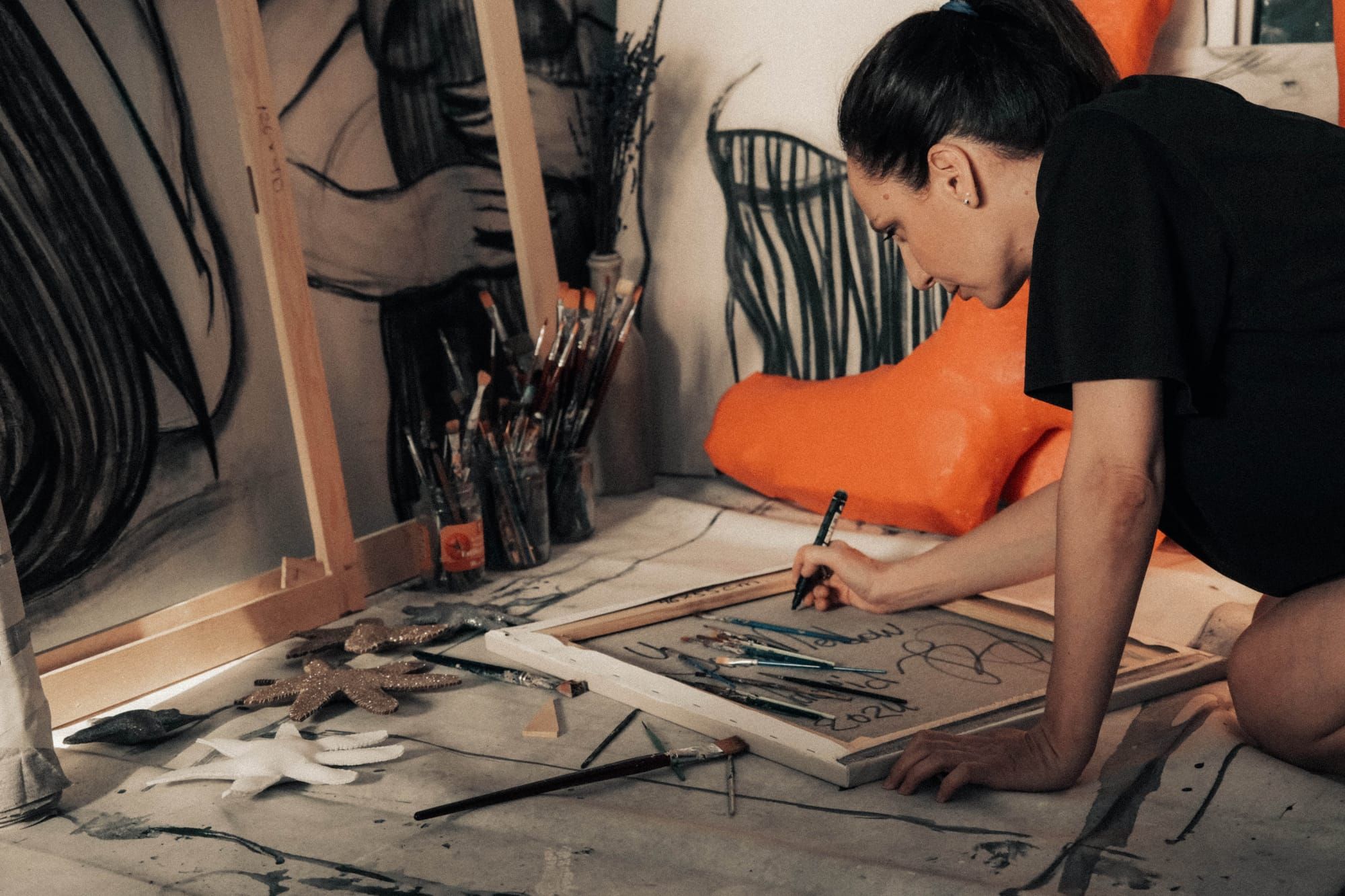
I love working in my studio when soft light is coming through the window. I also usually listen to audiobooks while I work. It creates a calm atmosphere and feels like having a quiet companion in the studio while I paint.


Has there been a moment in your life or in your work when you have realised that you had something, that you were where you belonged. Tells us about that.
I think for me it was not one dramatic moment, but rather a gradual feeling. Over time, I realised that painting had become the place where I feel most natural and most myself.
Whenever I enter the studio and begin working, I have a feeling that I am exactly where I’m supposed to be.
What are you watching/listening/reading at the moment that you can recommend to us and why?
I generally love watching new films because something always ends up inspiring me. Strangely enough, I’m also deeply inspired by fashion campaigns from brands like Saint Laurent and Dolce & Gabbana. I sometimes feel that my characters secretly live in that universe somewhere, walking around dramatically, wearing oversized sunglasses, and behaving as if every ordinary moment deserves cinematic lighting.
What advice would you give to any artists out there who are at the start of their career?
Always believe in yourself and keep believing in yourself. I think this is the most important thing, because I believe in you too!

We're constantly on the look out for new artists, creatives and initiatives to feature in TheNeverZine - so if you are, or know someone who is going their own way and doing their own thing on their own terms and would be a good fit to feature please smash that button below and get in contact. By talking to each other, and sharing our journeys, ideas and insights on creativity, art, mental health and resilience we can all create, share and thrive together. Nice thought that.
PS - Don't forget to subscribe below for more content from TheNeverPress 👇