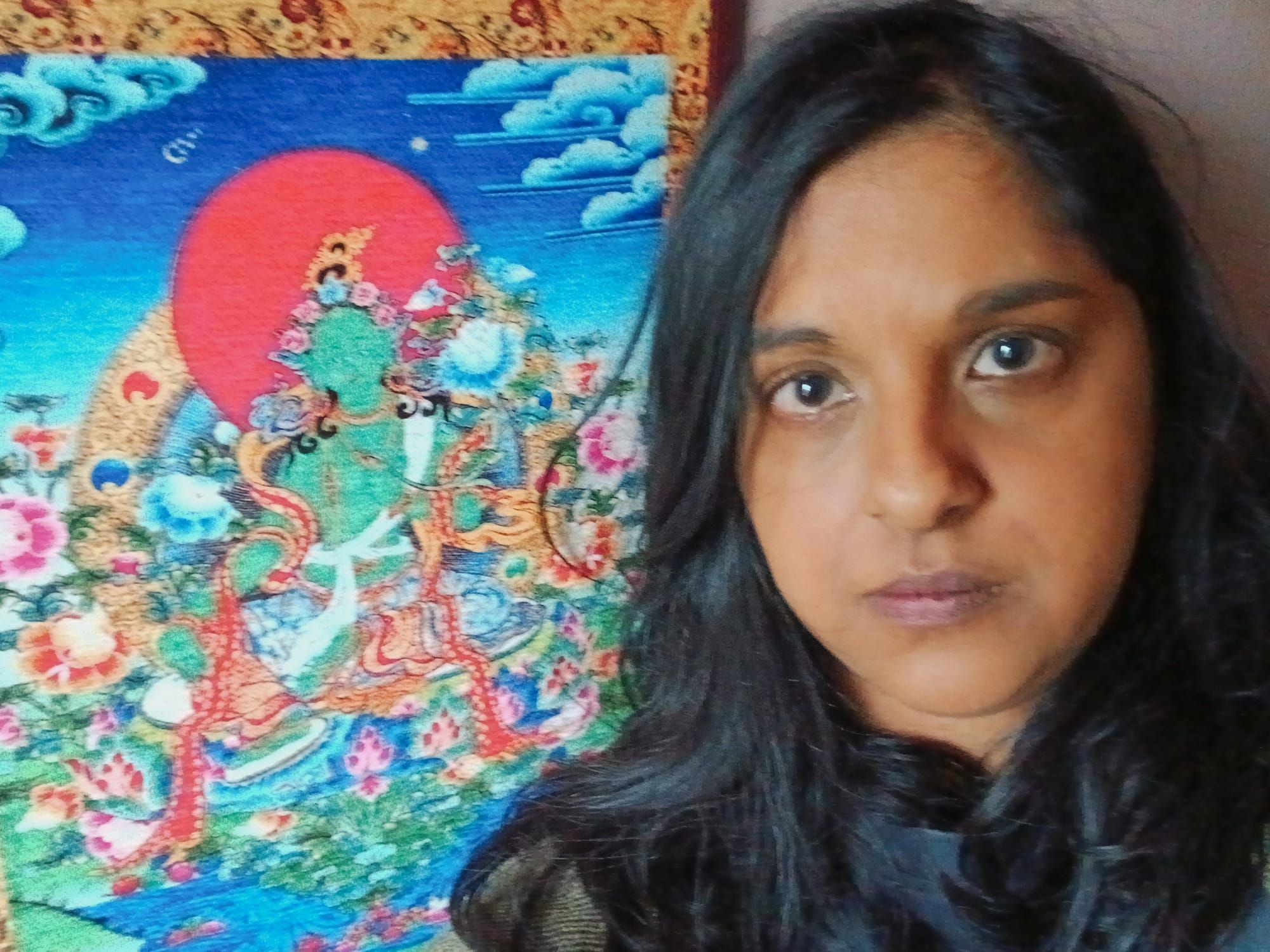
We're thrilled to bring you this interview. Farah came into our orbit, out of the blue by contacting us and asking if we were interested in reading their work. We were interested. We were blown away... but more than that, it was Farah's voice and their outlook. This artist had arrived to us so fully formed and brimming with talent and ideas, it felt like they had been sent to us. So we had to get the Big Interview going and we had to chat about further collaborations - digital work, print work, everything really. You will be seeing a lot more of Farah Rahman in the future as her career expands in exciting and dynamic ways, and some of that might be under the banner of TheNeverPress...a prospect we are absolutely buzzing about. So, keep one eye on that, and the other eye on this brilliant interview with the great Farah Rahman. Let's go!
Hi Farah! Here we are! Let's go right back to the beginning - may you please tell us about your creative journey?
I wrote a lot of bad poetry as a teenager, then turned my attention to prose in my twenties. I joined a couple of creative writing courses run by the (now legendary) Centerprise Community Project in Dalston, Hackney. I was taught by the poet Martina Evans and the novelist Jacob Ross. I began to write short stories, and got a few published in small literary magazines. I remember trying to 'copy/not copy' Raymond Carver and Charles Bukowski in my style, and I think they were important early influences.
In 2018, I was lucky enough to be accepted for a fully funded residency at the Guest House Project in Cork. I spent the month collecting sounds around County Cork on a second-hand iPhone and combining them with spoken word. I discovered that strong winds, or even gentle ones, can be the enemy of a good recording, and that learning to listen the way a musician does can be incredibly fruitful for a writer. Dialogue can be musical, for example, and every region of a country has its own preferred notes and patterns. I mainly edit my fiction by reading sections out loud into my phone, then play the recordings back a few times to hear where the rhythm and meaning feel disjointed or strained.
What themes and motifs drive you?
The tension between what’s spoken and what’s left unsaid in relationships interests me a great deal, partly because so much can rest on that balance. Someone recently told me there’s a sense of impending tragedy in my stories. I think I worry about the environment and the ongoing scourge of war, and the doom creeps into my work that way. Music-wise, I’m a goth, so perhaps I just have a dark sensibility. Humour is becoming more important to me, though, and I’m currently working on a series of fictional blog posts written by ‘Molly’, an AI-trained teenage brat from the future.
What are you seeking to unlock?
I think I’m trying to show how much I care about the world, despite feeling ‘locked-away’ by my mental tendencies a lot of the time.
Writing is an act of love that I wouldn’t know how to express in any other way. I’m bad at talking on the phone, for example.
How do you work with and manage your writing with your neurodivergence?
I’m working on an Arts Council grant to access some neuro-affirmative mentoring at the moment, as I think my strategies need to widen. I came across Spondylux Press online, and they offer a specialist access mentoring service for writers with ADHD, autism, or AuDHD. I fall into the latter category, with issues around sustained concentration, and I’m hoping to build an editorial skillset that will help me write more efficiently with my neurodivergences. I was late diagnosed, and I haven’t written as much as I’d like because I think I’ve been trying to work everything out on my own.
You’re currently working on a novella, how are you navigating the change in pace from short story to medium-form? What has surprised you about it?
I use my average short story word count (around 2,000 words) as a guide for how long my chapters should be. That way, I’m working in units of writing I know I can achieve, and I feel a little less intimidated. I also split the story into three acts before I start, and make an index card for each chapter before I start writing. I’m still very much learning how to take 60,000 words of detailed notes and build the architecture of an exciting story.
My short stories tend to be slow-paced, whereas when I’m working on the novella I feel a pressure to get through ‘events’ because of the twists and turns I have planned. I keep needing to go back to flesh out the descriptions and add humanity to the dialogue. What’s surprised me the most is that, despite being quite an intuitive writer, I have to create an admin system for character notes, world-building and structure. Otherwise, I get overwhelmed and want to give up.
How do you know when it’s done?
I usually think something’s finished before it is, out of wild optimism, to start with. But I have an insurance policy of leaving a story to rest for a month before I reread it and decide. Generally, I mainly see only flaws when I look over my work again, and I’ll want to burn it, but I don’t. I recover my self-esteem and rewrite until I feel I’ve done what I can. Then I hand it over to a writer friend or my partner and ask if the piece makes sense. I basically don’t know when something is completely done until someone else reads it.
Short story writing is a great skill – one that requires great discipline to stay focused and get down the nub of the matter. How do you approach this?
For, me it always starts with an idea caught while daydreaming. If it keeps growing in scope in my head while I’m doing housework, sitting on trains and teaching students for a few days, I sit down and do one long session of stream-of-consciousness writing. This usually contains the basic materials for the story. I walk away, come back, read it all again, and chip away at it intuitively for a few weeks. Eventually, rewrites turn into drafts, and I focus on increasingly detailed elements with every revision.
My writing process is mainly sustained by daydreaming as well as reading other people’s stories and discovering what I love most about their work. I’d be lost without my reading practice.
You like to collaborate on your work, as noted with your partnership with illustrator Ritam Baishya. How do you approach this? What is the workflow like?
My collaborations been coincidental rather than planned, but I do like working with artists from different disciplines. During my residency at the Guest House Project in Cork, a friend of mine mixed and produced a soundscape that incorporated parts of my recordings from a Tibetan meditation centre in the background—a place I’d visited in Allihies on the Beara Peninsula. It was a very gorgeous piece that just involved me trusting him to do what he does best. (It’s by Dave Smith and is on my Soundcloud account somewhere…) I worked with the cellist and composer Eimear Reidy, who was based locally at the time, after she chose one of the recordings to improvise to. It was a powerful piece of music that she wove intuitively around what she felt as she listened. We met a couple of times in advance, and through conversation the work evolved naturally.
I came across the work of Ritam Baishya on Unsplash and reached out to him after I saw that a few of his illustrations went perfectly with a few short stories I’d written. I was putting together a chapbook to sell as a fundraiser for Nordoff and Robbins, the UK’s largest music therapy charity. I reached out on Instagram, and we took it from there. It’s about finding the right people, for me.
I was very quiet when I was younger and I think writing became a way of communicating without speaking in a way that felt comfortable.
What inspires you day to day?
I don’t have to wait for the muse; it pecks at me all the time and I need the discipline to sit down and write. I have too many ideas and a lot of things inspire me. Nature. Flowers (forget-me-nots, bluebells and heather are some favourites). The way pigments for painting are made from natural materials (I’m eternally in love with ‘lapis blue’). Childhood memories. Dreams. Snatches of conversation overheard while out and about. A particular building that catches my eye, or a piece of music. I’d like to write a collection of stories inspired by Kate Bush songs, one day.
Who or what have been great influences on your work, outside of your chosen medium?
Kate Bush, The Cure, Bat for Lashes (aka Natasha Khan), Jane Campion.
Your voice: Was it there from the start, or is it an ongoing quest to discover and define it?
I’m not sure how common this is, but I spent many years feeling torn between different creative directions, which was closely tied to finding my voice. I couldn’t decide between short stories and novels, between literary fiction and science fiction, or even between adult and young adult fiction. There was a lot of doubt and a lack of self-confidence. My undiagnosed neurodivergencies didn’t help, as they often got in the way of organising my life well enough to both write and earn a living.
It was only when my housing situation improved and I got some good therapy that things began to settle. I committed to a regular writing practice, and my voice gradually became clearer. It takes time, I think—or at least it has done for me. After building a new well, the water has to be drawn several times until it runs clear. Every time I try to write in a new way, I do have to start the process again. For example, I’m teaching myself how to write memoir-based essays at the moment, and am reading and examining Roxanne Gay and Baek Sehee as ‘models’ to appreciate and learn from. My first attempts at memoir are pretty cringe-worthy, though there are bits that shine in all the muck. I’m learning how to write all over again, really, as I’m not accustomed to putting myself into scenes.
How can art help us?
For me, art is about the joy of creativity, but also about reflecting on life on this earth where both suffering and beauty are powerful parts of our lives. It’s hard to hold, to fathom, all these contrasts, without art to help us.
I believe there are ongoing human conversations that extend far beyond the limits of any single lifetime. Through art and philosophy, we can commune across distance and time.
Has your art positively helped your mental health in any way?
I can’t really imagine my life without writing and music. I would do very badly under a totalitarian regime. Punk gets me through times when I feel that the world is being fucked by inept leaders.
How do you like to work?
At home, with my cat Delphi curled up beside me. I’ve tried being an early morning writer, but that really didn’t work out for me. I’ve accepted that I’m more productive afternoon onwards , with a preference for night writing.
Sometimes it’s better to leave an idea that isn’t working and move on, and sometimes it’s better to keep going and wrestle it into being. How do you know when to step away, or when to push on?
I rely on a third party to help me in situations like these. I need to get a detached reader’s perspective. I ask my partner or a friend if they think there’s something worth saving in a story.
Sometimes, when things really aren’t working, I consider whether it’s a matter of choosing a different focus within the story. For example, I might try a different narrator/ main character, and see how the things feel from a new point of view.
Sometimes you do have to kill your darlings. But I stand by the principle of never destroying or deleting any of my work, in case I find something, years later, that could bring the project back to life.
I’m currently working on a novella that I first drafted in 2016. At the time, I wanted to destroy the manuscript because writing it coincided with a period of ill health. Thankfully, I kept one draft. I don’t even know which draft it was, but I found it last year and decided to rewrite it with a new main character. I’m so glad I didn’t shred it!
How are you watching/listening/reading at the moment that you can recommend to us and why?
I re-watched a film by Radha Blank the other day, and it’s been up on Netflix forever… It’s called The Forty-Year Old Version, and it’s autofiction shot as a documentary about a mid-life, black female playwright from Harlem. She faces choices about what ‘selling-out’ looks like for her, and what kind of art really makes her heart sing. The choice is: do you change your voice in exchange for a broader audience, or follow a creative path that you know will alienate the powerful and ‘respectable’? It’s a great film about making art with some laughs along the way.
What advice would you give to anyone out there who is starting out on their writing journey?
Choose a writer you like and see if they run creative writing classes. I learned a lot from doing this— it’s cheaper than an MFA and you get to learn from someone you admire professionally, so their advice is worth so much more!

And there we have it, a beautiful introduction to a fantastic artist who will be working with TheNeverPress on a variety of projects. It just proves that you never know what blessings may come you way. Farah came in from the cold with an email out of the blue and here we are, preparing all sorts of weird and wonderful projects. This is how we do at TheNeverPress - we're constantly on the look out for new artists, creatives and initiatives to feature in TheNeverZine and to work with at TheNeverPress in general - so if you are, or know someone who is going their own way and doing their own thing on their own terms and would be a good fit to feature please smash that button below and get in contact. By talking to each other, and sharing our journeys, ideas and insights on creativity, art, mental health and resilience we can all create, share and thrive together. Nice thought that.
PS - Don't forget to subscribe below for more content from TheNeverPress 👇