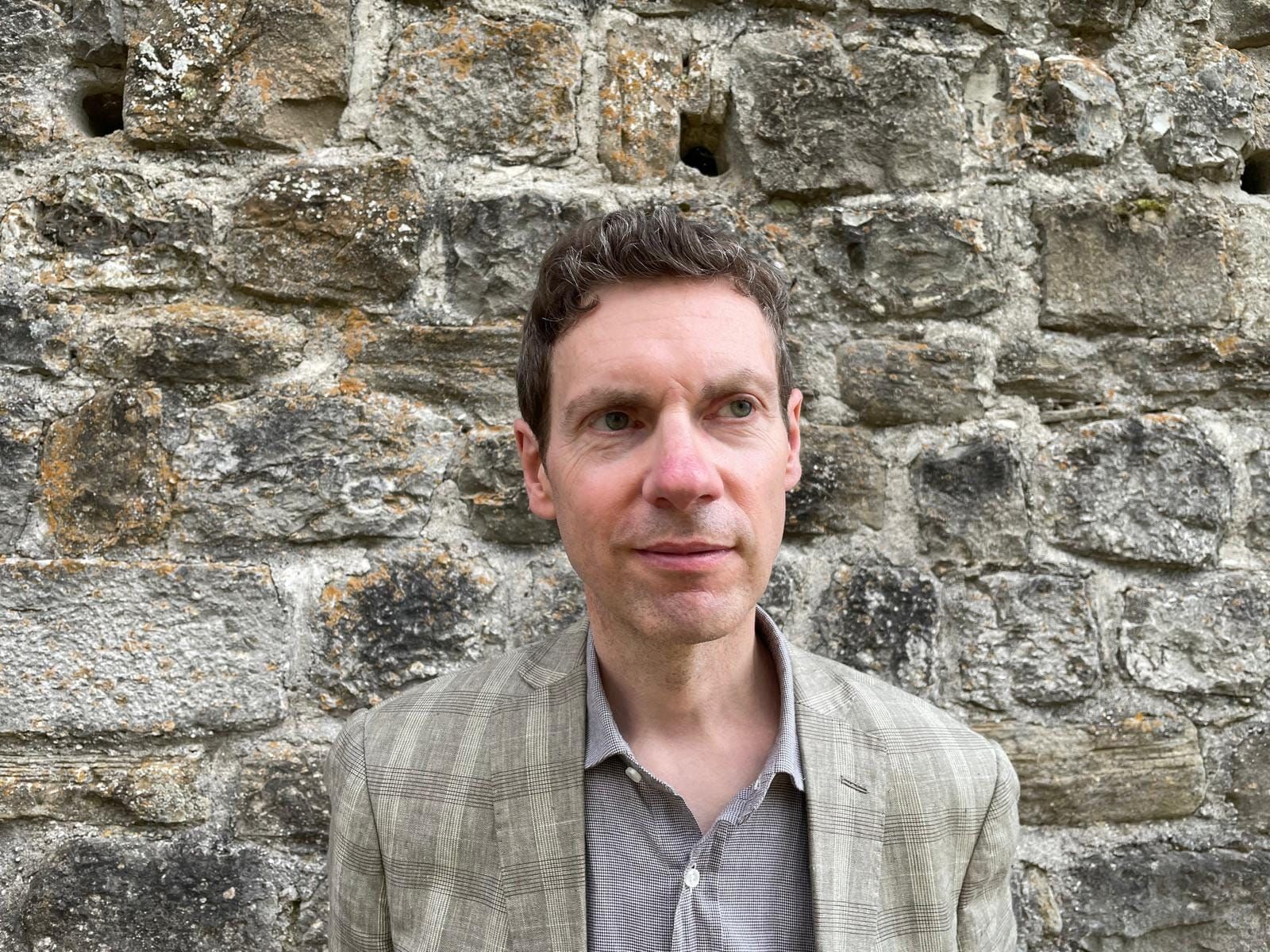
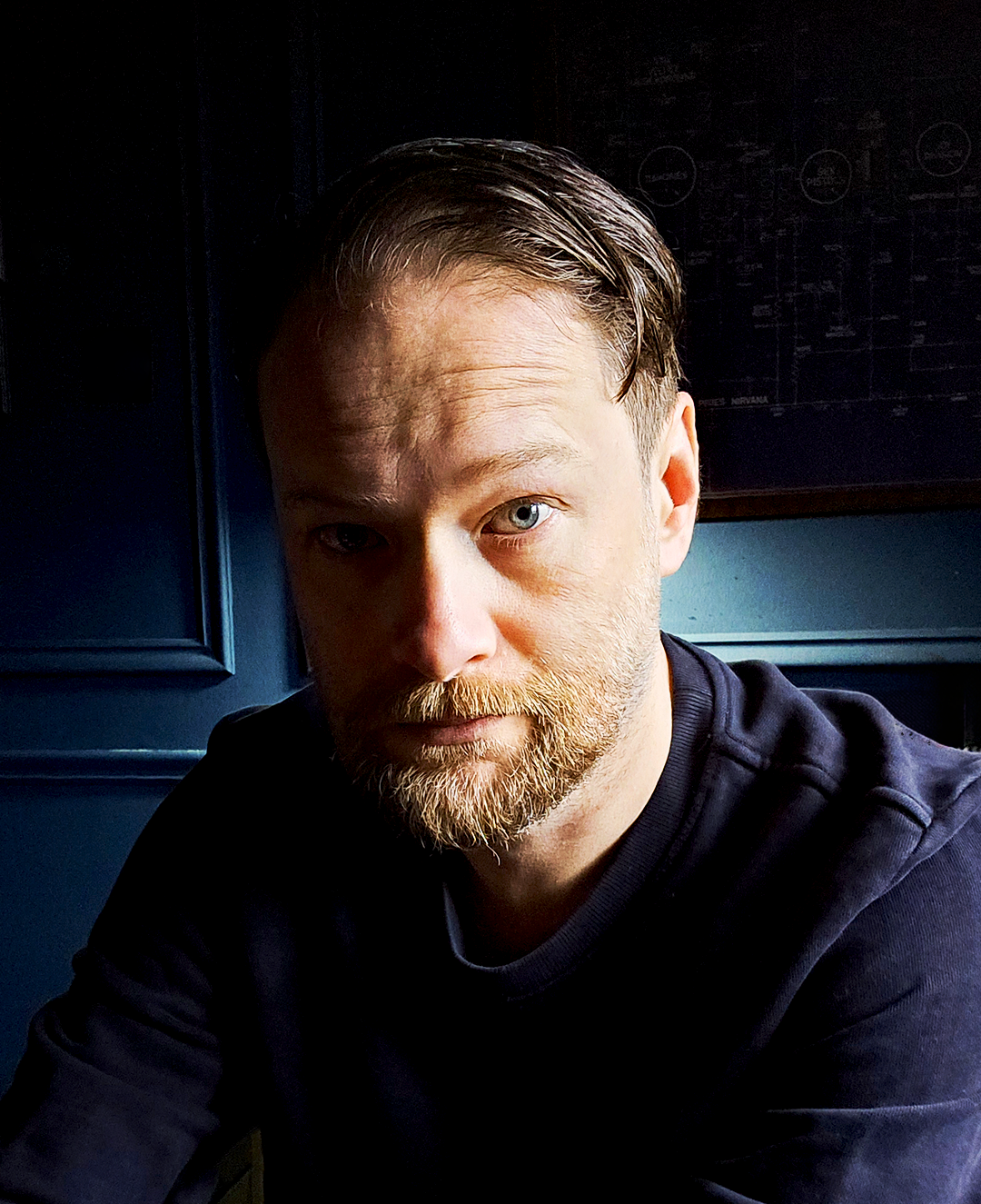
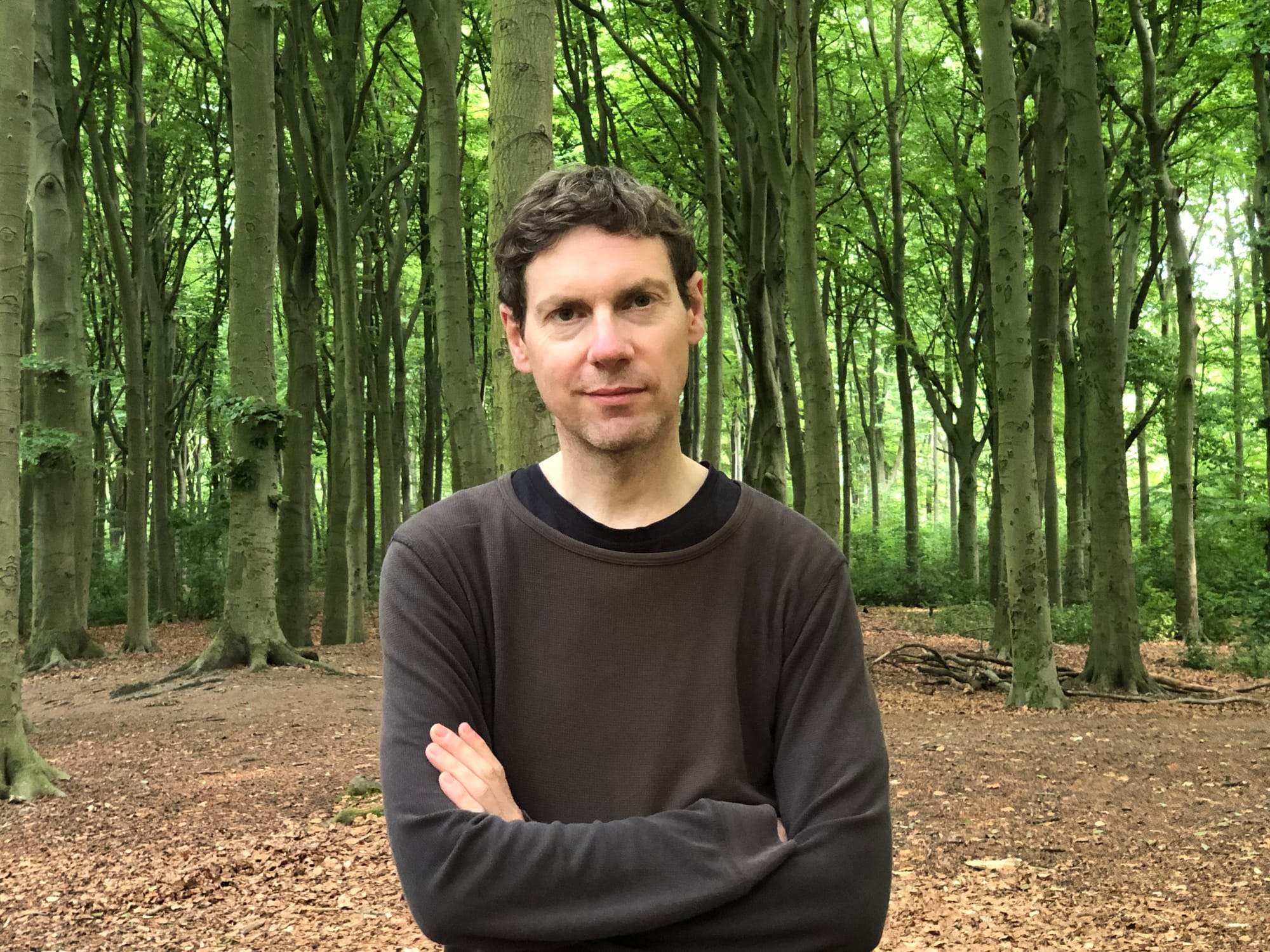
Robert Monk - poet, artist, performer, storyteller. Robert came to us through our submission path. An artist in from the cold.
We hoped on the phone for a chat, despite living in the same city (the curse of the stacked modern diary!) And we had an immediate rapport. Robert was charming, eloquent and gifted with wry and compassionate sense of humour complemented with a touch of the gallows. Their work runs with a similar streak of humour, mixed with satire, political anger and personal experiences that combine to form a very relatable, human voice. It seems the here, distance between the person and the art is very short indeed - connected to themself and to the work around them. It's our pleasure to be working with Robert on some print and digital projects in the near future, but for now, we bring you our chat...
Hi Robert, great to spend time with you! Let's start as we always start - with your creative journey. May you please tell us about that?
I have always liked to use my imagination from a very young age. I liked simply telling stories and tall tales as a kid, not lying exactly… but just making things up on the spot to inspire… myself, mostly. Daydreaming, some might call it. This would be before I could write. I think the very young of our species, as well as the older ones too, are in touch with something other that we can barely express.
Anyway, writing ideas and made-up myths and tall tales went on for me. Legends from around the world and fairy tales that I heard and read played into this and helped to stimulate my creativity. From there, a passion for the written word as well as visual form took hold early on. Comics (mostly Marvel and DC, some indies) were naturally a big influence.
How did you come to poetry, or has it always been with you?
I have always liked to jot ideas down in short form. Whether that was/is poetry or not depends on the reader, I suppose. For a long time, I was slightly resistant to the big scary word ‘poetry’ to describe what I do. I even called it ‘poe-try’ at one point to convey that I was merely having a go. As I’ve got (much) older, I realise that poetry doesn’t have to be a scary term. Well, unless it wants to be. I had a very good teacher back when I was 9 or 10 who encouraged me to just express my thoughts and feelings and not worry about the form too much.
What themes and motifs drive you?
Most of the time I’m trying to describe how I feel about the world and my place in it. Themes of individual and group consciousness, the unexplained, social injustice, and how to connect to other consciousnesses are themes I return to. I am driven by trying to understand more about myself, and in doing so, understand more about the world, the reality we share, of things that are challenging to express, but also the things we instinctively have in common.
7th Wave Part 1
What are you seeking to unlock?
I often write to entertain myself. I’m trying to illustrate things about myself that might be obscure to myself. By looking at these aspects, I can hopefully find out some things about the world outside as well.
How do you know when it’s done?
I don’t think anything’s ever truly ‘finished’, but I’ll be content to leave something alone if it’s something I find entertaining, or moving, or funny.
Do you perform your poetry publicly? And if so, tell us about that process – how do you prepare and what are you feeling when you’re behind the mic?
I started performing poetry nearly 20 years ago. I am naturally an introverted character, and I initially sought out performance as a way to challenge myself and my innate shyness. That plus alcohol use would coalesce in some ‘unpredictable’ performances. I now realise I am far from unique in this! Nowadays, I’m a lot more restrained . The nerves before going onto stage are still there, of course. Preparation is pretty much going through my selection, having some things I can swap round if necessary, and practising in front of a mirror and perhaps timing it for whatever slot I may have.
The feeling of being right in the moment at the mic stand is positive and intense. I’m locked into my delivery and ensuring that I am speaking clearly and audibly. The emotion after a set of having got up there and revealed something of myself to a crowd is not something most of us experience every day. I have found it really rewarding.
7th Wave Part 2
You combine illustration with your poetry, what comes first and what is the relationship between them?
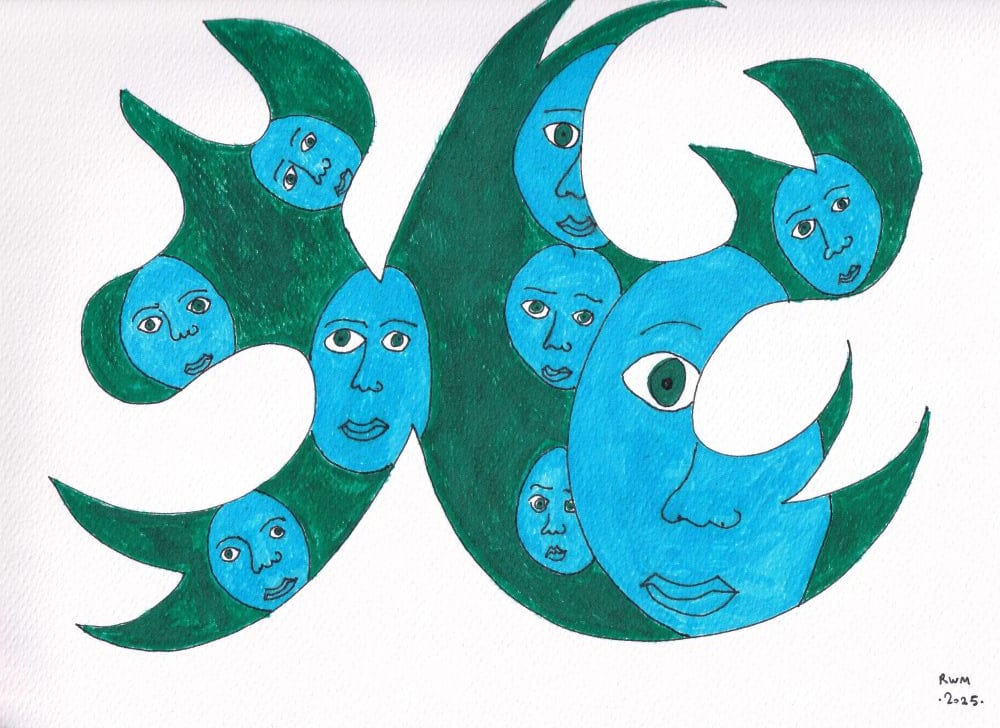
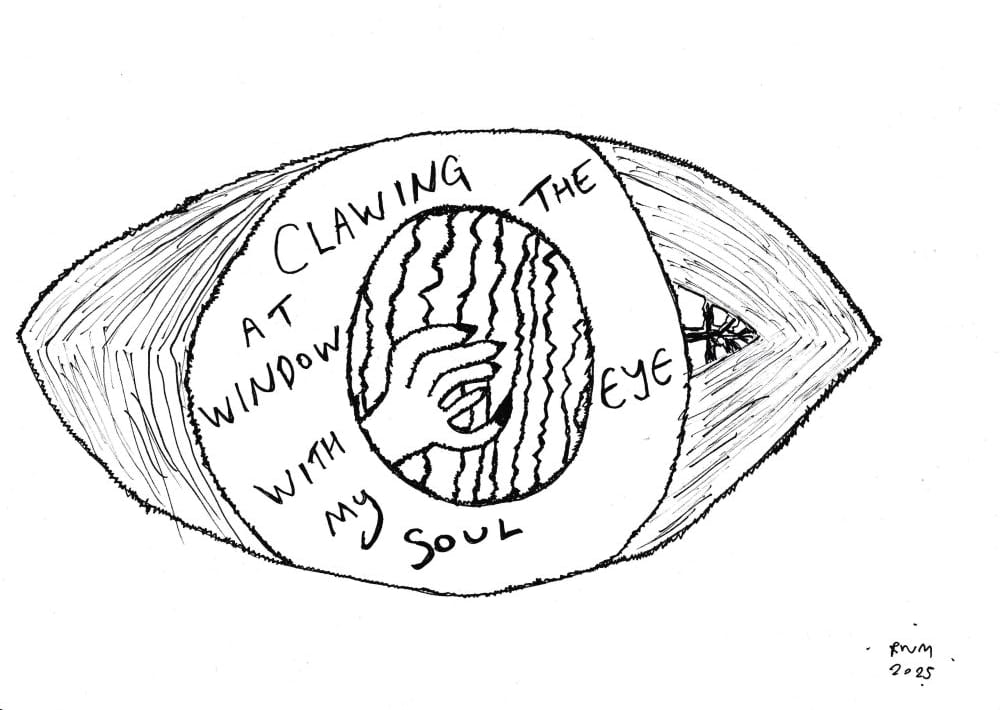
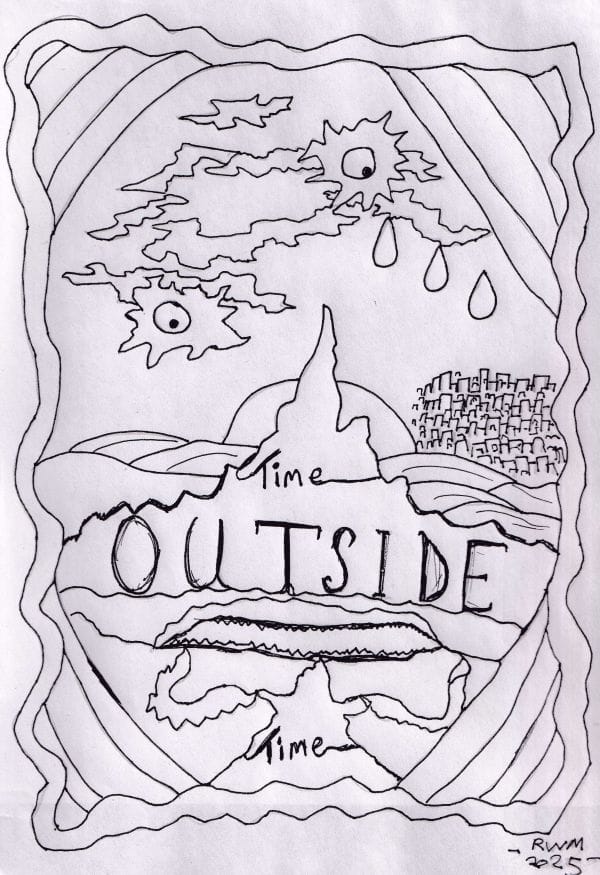
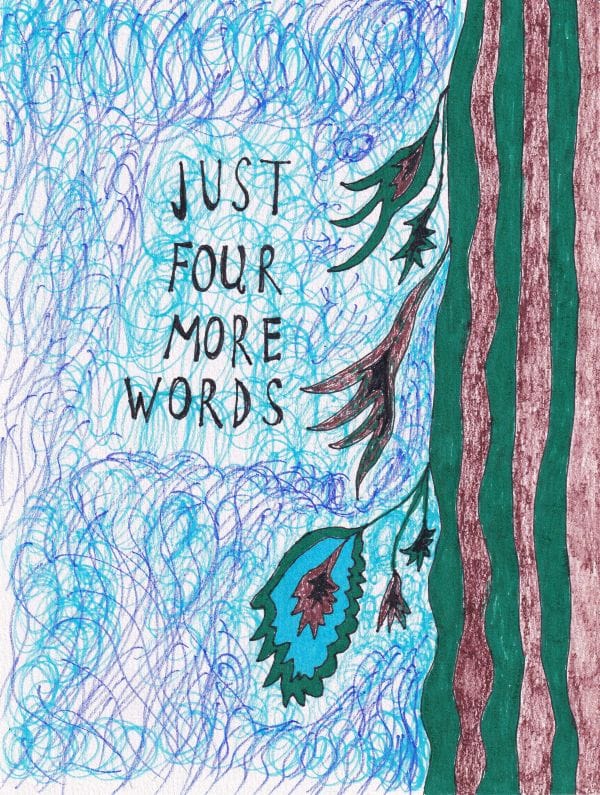
It depends. I love to sketch and just draw. I often combine bits of lines in the drawings. Other times, I’ll have a poem that has been sitting around in my notebook for a while, and then I’ll sketch an artwork to accompany it. So, it varies. The thing I like about sketching is that I just let myself go with it. I have never been much of a technical artist. I just draw weird stuff. And I don’t put pressure on. Illustrations offer a counterpoint to the poems, almost like a distorted reflection.
How is it important for people to feel that they can express their voice?
I think it is integral. Having our voices heard is essential for people everywhere in the world, across all sorts of communities. If you look at political movements throughout history. Creative expression is fundamental to getting ideas out there. It’s the same with people. I think everyone can write. I think everyone can create. It’s all perception. I think creative expression is therapeutic in the sense that it is something available to all, and it puts you in touch with something that is wholly and uniquely you. That’s got to be a good thing.
You’ve been writing constantly for decades, working in zines, pamphlets and collections. Do you start with a project or goal to work towards, or is the work more of an on-going journal or reflection of where you are now, and where you have been?
I often work well with others. I co-created a zine back in the late 1990’s with a couple of good friends called Passenger Pigeons, which ran to two issues. It was a print and photocopy job. Long stapler at the ready to keep the A4 pages together. I can’t remember how I publicised it pre-internet, but trips to the post office to send out copies took place somehow. Another zine, Section 5, was done in the mid to late 2000s with another good friend to sell at the South East London gigs that we put on under the moniker Shot by both Sides. I also did a split zine quite a few years ago as a collaboration with the artist and musician Jack Duckworth aka Soft Riot. So, they were all pretty specific goals and outcomes. Linked to this is the fact that I enjoy collaborating with other people. I have also done this musically contributing my words and voice to experimental music productions over the years, mostly with Olaf Boquist as Temporal Fix. If the aim is to write responding to a call out wanting a specific theme, or if it’s for an anthology, then that will inform the goal. I suppose the overall goal for me is always to have something I can see some merit in.
What feelings come up when you read back over your earliest poems?
If I go way, way back to very early stuff, it’s reading the work of someone I kind of vaguely remember, but I know it isn’t me. Some of it might be quite sad, but there is hope in there. It’s a bit like looking over old diaries.
You have an urge to reassure the young you that things will get better, and if they don’t, that you will be OK, and the writing is helping.
You have lived with MS for a long time, how does the change in circumstances (or even the stasis, if it is so) reflect in your art?
Living with multiple sclerosis is unpredictable. It affects people in countless ways. For me, the biggest change was that I began to look after myself better. That isn’t just to do with diet and exercise, but also being less demanding of myself, less self-critical. I think I have developed a greater empathy and awareness of what others may be experiencing as well, which may not be obvious. I think this is reflected in my art that has become more outward-looking, more ready to engage. Except, on low days when the art just wants to lie down in a darkened room.
Where does it come from?
Things I’ve seen or heard. Dreams. Fractured memories. Misremembered conversations. Sometimes I might remember something I did 40 years ago, and it might just trigger a description or turn of phrase. For example, I remember being a small child walking in wildlife around a small wood near a pond and being aware of everything that was there, and just feeling really alive and a part of everything. The birds in the trees, the fish and the ducks in the pond. I was in that world, not kept out of it.
What inspires you day to day
The way that the branches of the trees outside are swaying in the breeze. The swift movement of something unknown moving behind a wall as I walk past. The feeling of water. The constant tumult and unrestrained energy of the city.
Has your art positively helped your mental health in any way?
All the time. Art inspires and engages. It connects people. I have experienced depression and anxiety throughout my life and art is there as a grounding force and as an uplift.
I feel compelled to write and sketch even if I don’t necessarily ‘want’ to. It’s just always there, like the sky and the moon.
How do you like to work?
I don’t have any specific rituals. A desk is useful. But I also like to carry a notebook around and jot down ideas as they come to me. I walk around a lot. I find that’s often when ideas come, so I need to be able to jot them down in my pad or in my phone. I draft things out in long hand, then write them up on my computer.
Insomnia Wave
Sometimes it’s better to leave an idea that isn’t working and move on, and sometimes it’s better to keep going and wrestle it into being. How do you know when to step away, or when to push on?
If I’m finding something isn’t flowing, I’ll just put it away and look again in a few months. Things can look different after some time has passed.
How are you watching/listening/reading at the moment that you can recommend to us and why?
I’m always reading. I recently discovered the work of poet Amy Key through her memoir Arrangements in Blue – Notes on Love and Making a Life – which is filtered through Joni Mitchell’s ‘Blue’ LP. It’s a fascinating account, and has the raw human emotion and melancholy uplift in common with Mitchell’s album. I am a big film lover and recently enjoyed the so-called liminal horror of Backrooms. Also enjoyed checking out the related internet YouTube work of the director Kane Parsons. I appreciated the Lovecraftian oddness of weird angles in interiors, that may be hinting at internal and external trauma. Not everyone's cup of mead, I suppose. But I liked it!
What advice would you give to anyone out there who is starting out on their poetry journey?
Write it down. And then write some more! Don’t worry about profundities. Just write.
We're constantly on the look out for new artists, creatives and initiatives to feature in TheNeverZine - so if you are, or know someone who is going their own way and doing their own thing on their own terms and would be a good fit to feature please smash that button below and get in contact. By talking to each other, and sharing our journeys, ideas and insights on creativity, art, mental health and resilience we can all create, share and thrive together. Nice thought that.
PS - Don't forget to subscribe below for more content from TheNeverPress 👇