Sometimes the sound of a shutter can reverberate around the world. A single shot that slices a fraction of a second from history.
Iconic images from the front lines of change, becoming part of the protest. With the power to make people pay attention and take action - Ieshia Evans' 'Taking a Stand in Baton Rouge' or John Filo’s Kent State University image of Mary Ann Vechhio kneeling over Jeffery Miller’s body. I recently visited the Tate Britain to see the Lee Miller exhibition, her WW2 and concentration camp coverage serving as a reminder of the horrors of human history. And, begging that we don’t repeat them. Her role and that of all documentary photographers is to deliver unfiltered truth through a lens.
The First Amendment of the United States of America Bill of Rights states that: Congress shall make no law respecting an establishment of religion, or prohibiting the free exercise thereof; or abridging the freedom of speech, or of the press; or the right of the people peaceably to assemble, and to petition the Government for a redress of grievances.
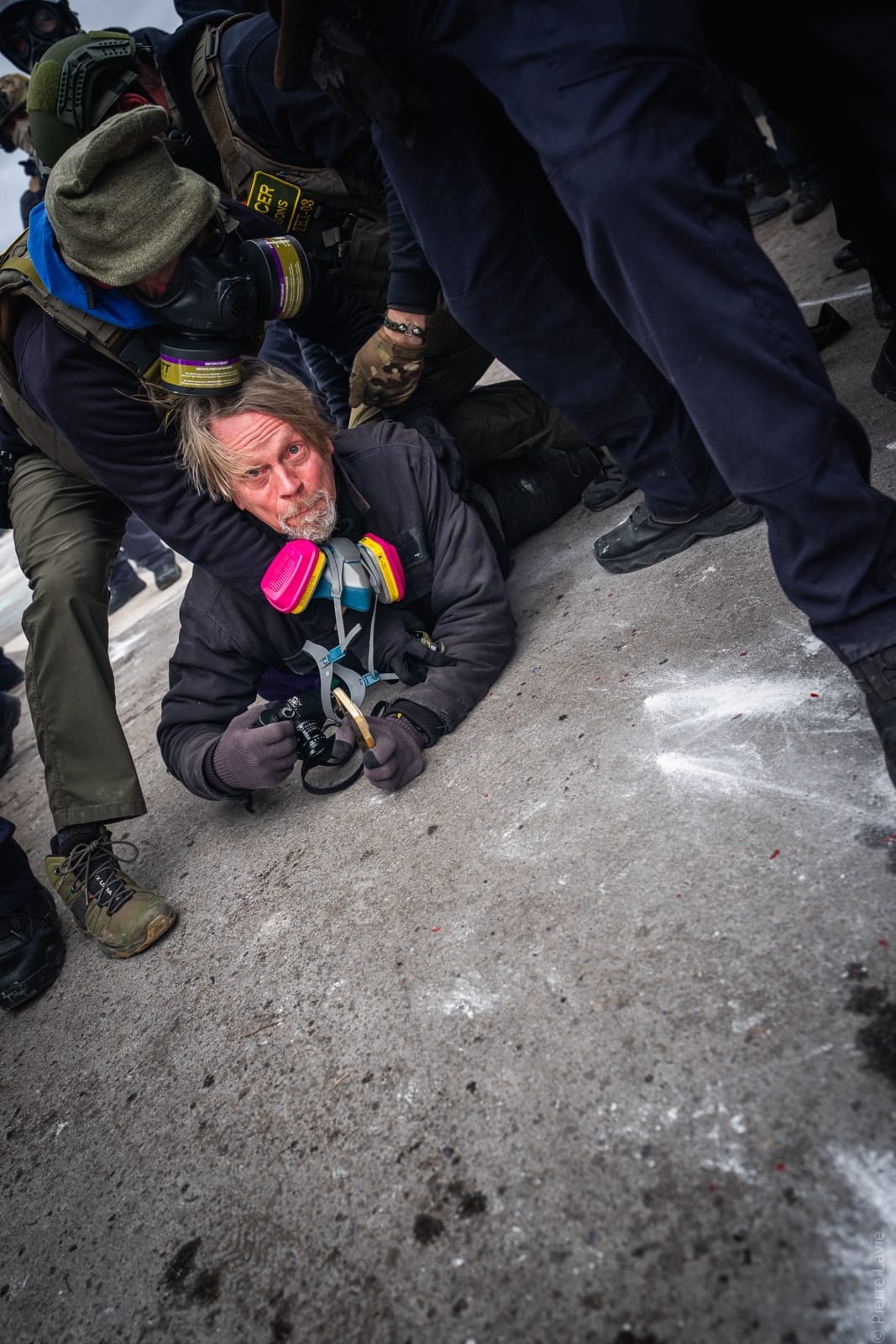
As a dual USA/UK citizen I have been fearfully watching the violation of those freedoms unfold across the Atlantic and have been actively seeking out those standing up for the right to let the world know what is really happening. Pierre Lavie’s photograph, 'The Detainment of John Abernathy' during his coverage of the Minneapolis protests in the aftermath of the killing of Renee Good by an ICE agent spoke deeply to me. Here was a photographer who, whilst being bruatlised, thought not of his safety, but of the importance of saving the truth in his camera. He threw it to fellow photographer Pierre Lavie who not only rescued the camera, but froze the frame. Here is Pierre and John’s account of that day, that shot and why documentary photography is more vital than ever.
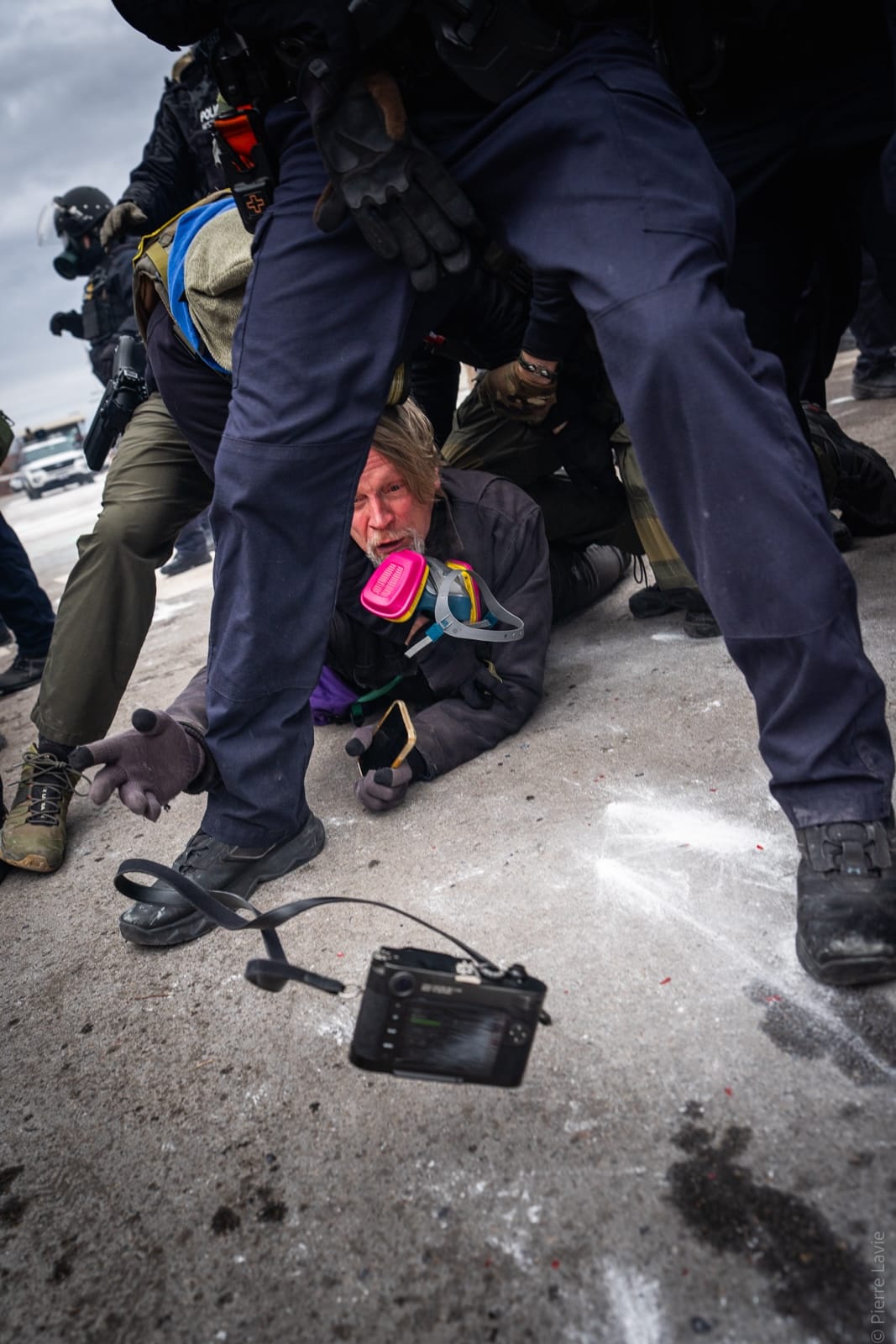
Pierre and John, the shot above, hits hard. I was at a talk with the legendary Don McCullin recently and he commented how rare it is now that photographers get close to real events. To capture images that tell the story of a moment and a time. This photograph does just that, and is a powerful statement on resistance and the importance of the press. Can you both tell us the story of how you came to be in that spot on that day?
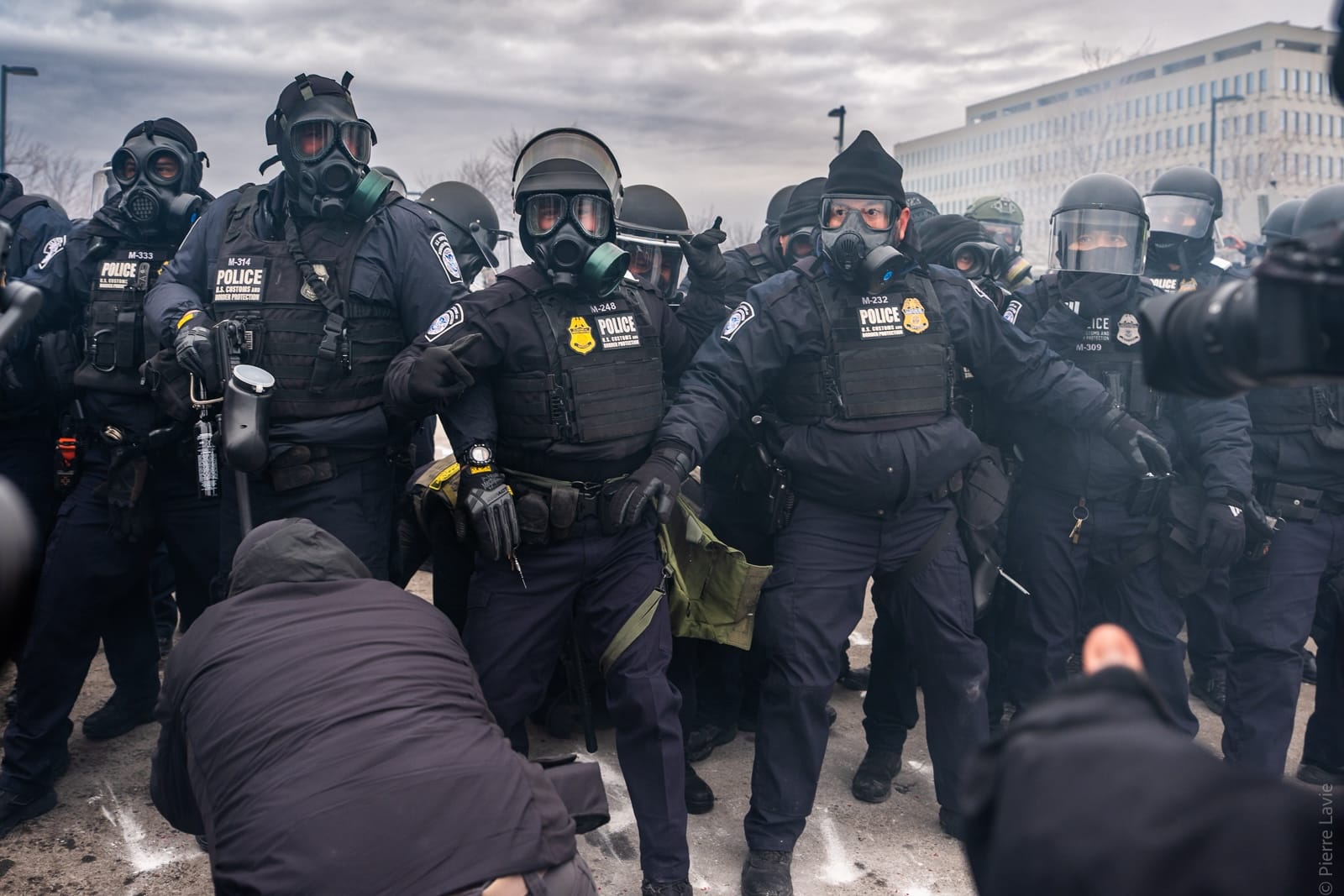
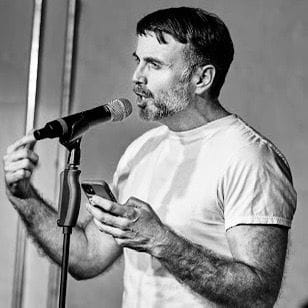
JA: I heard there was going to be a veteran lead protest at the Whipple Federal building on January 15. I got there about noon. When I got there there were only protesters on the opposite side of the street from the federal building. At some point approximately 80 or 100 agents came out and started doing push backs. They would push the crowd back and then retreat. Push the crowd back and then retreat. Multiple times I was taking photos with one hand and Facebook live streaming with the other hand. After one of the push backs I was all the way across the street and in the entryway to a parking lot. I figured they were not coming any farther. But suddenly I found myself face down on the ground and actually wondering how I got there. It took a moment before I realized what happened.
PL: I've been documenting ICE / Border Patrol activity for several months now across the U.S.. The Whipple federal building is a place where the police/feds like to come out and "interact" with the protesters standing out in front of the main entrance. I positioned myself in the middle of the protestors line when the police/feds made their push into the crowd. They tackled John just a few feet away from me, which caught my attention...so I focused on it.
Pierre, I have to know, did you save the camera?
PL: Yes, I managed to recover John's camera and phone with my left hand while shooting with my right and return both to him a few hours later.
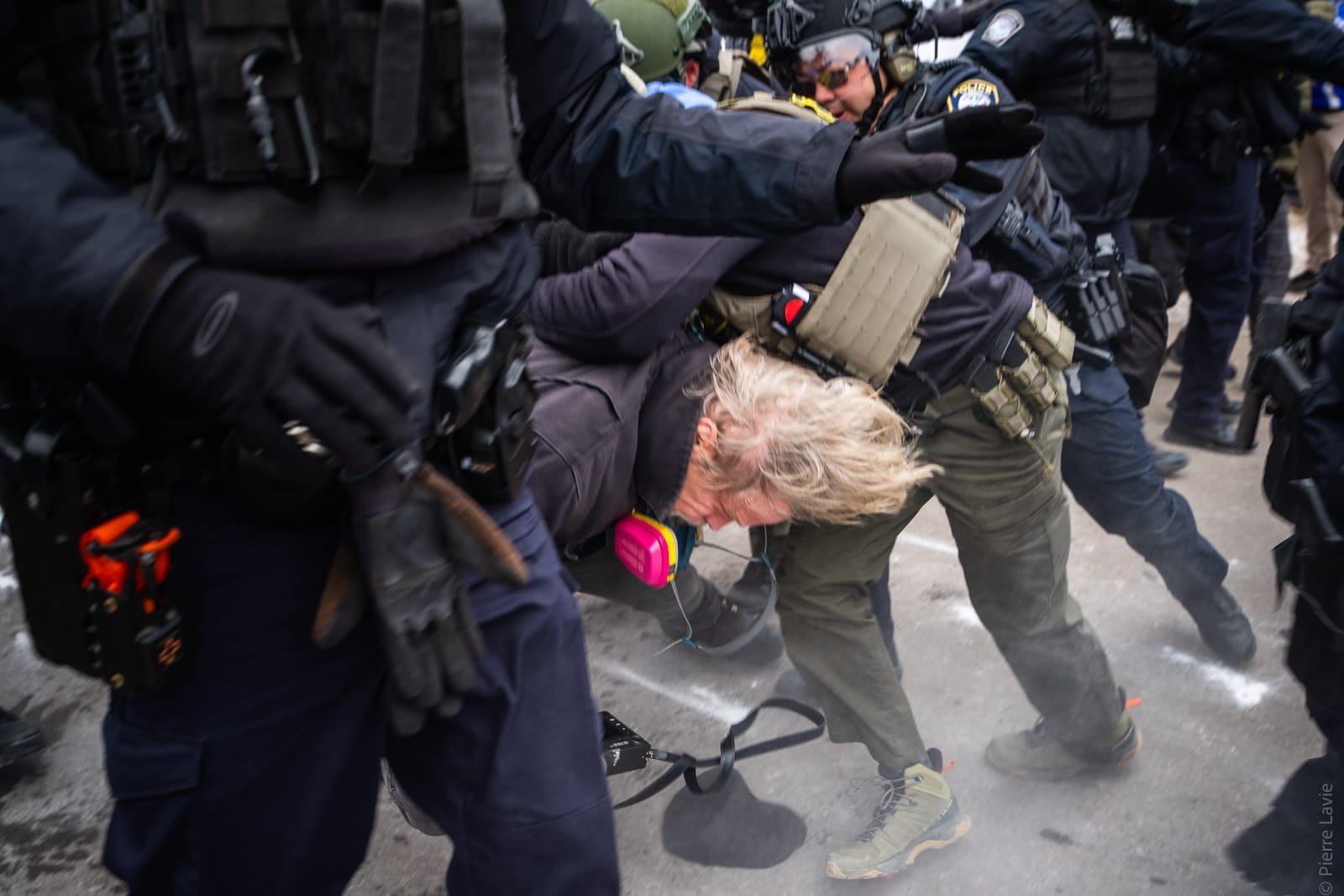
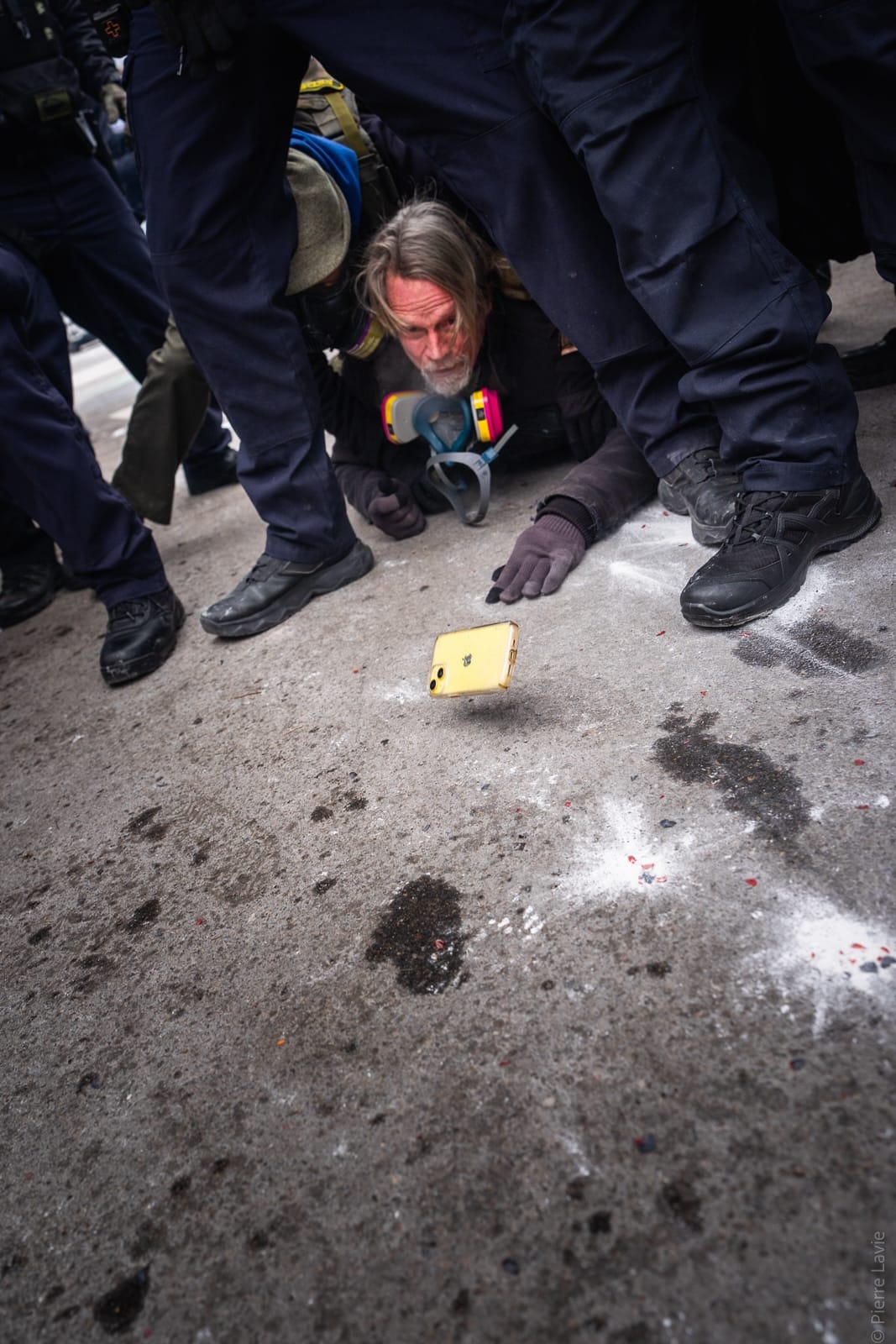
Photos: Pierre Lavie/@just1dudewithacamera
It’s brave to be out there on the streets right now, what is driving you to keep getting out there to shoot?
PL: What keeps me going is the belief that documentary work matters most when it bears witness to the kind of America we still hope to become. Emma Lazarus wrote, “Give me your tired, your poor, your huddled masses yearning to breathe free.” That promise—unfinished and still contested—is what I hold onto when I’m out there on the streets. I photograph because I refuse to let that dream fade into myth. Every frame is both an act of recording and of remembering—a reminder that freedom and dignity aren’t abstract ideals, they’re lived experiences we have to keep fighting for.
I do this work for my children, and for everyone’s children—for the next generation that deserves to inherit a country honest enough to look at itself, and brave enough to change.
JA: It's dangerous here and will get even more dangerous in this country if the world does not put a stop to it. The danger I was in seems to pale next to the dangers of the immigrant population seeing their son or dad ripped from their arms and taken away. It's imperative that the world sees what's going on. And it's imperative that they act in their own way.
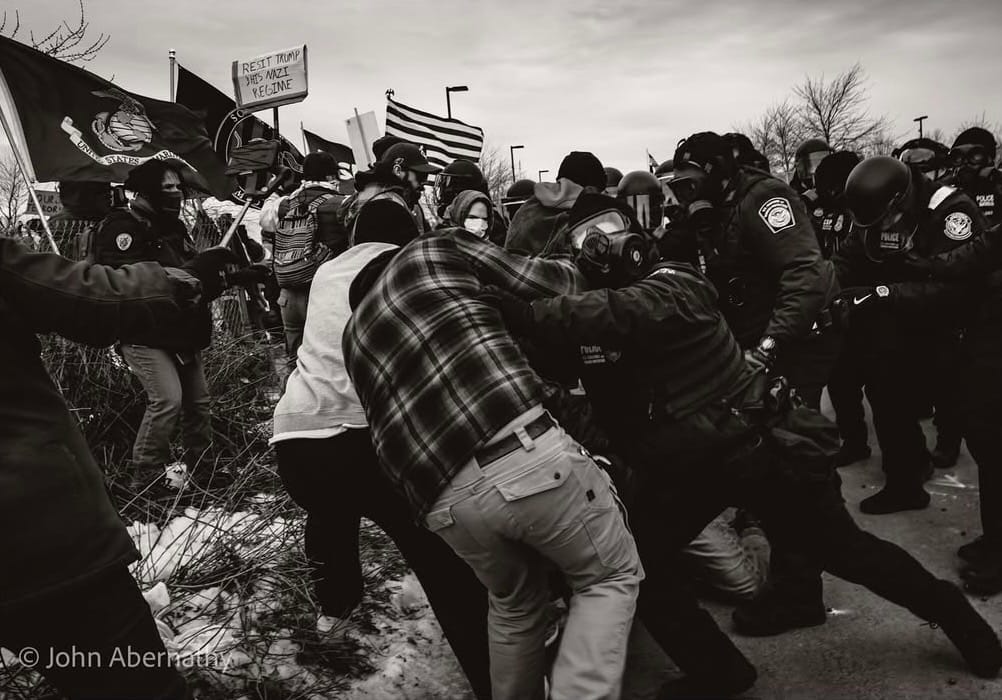
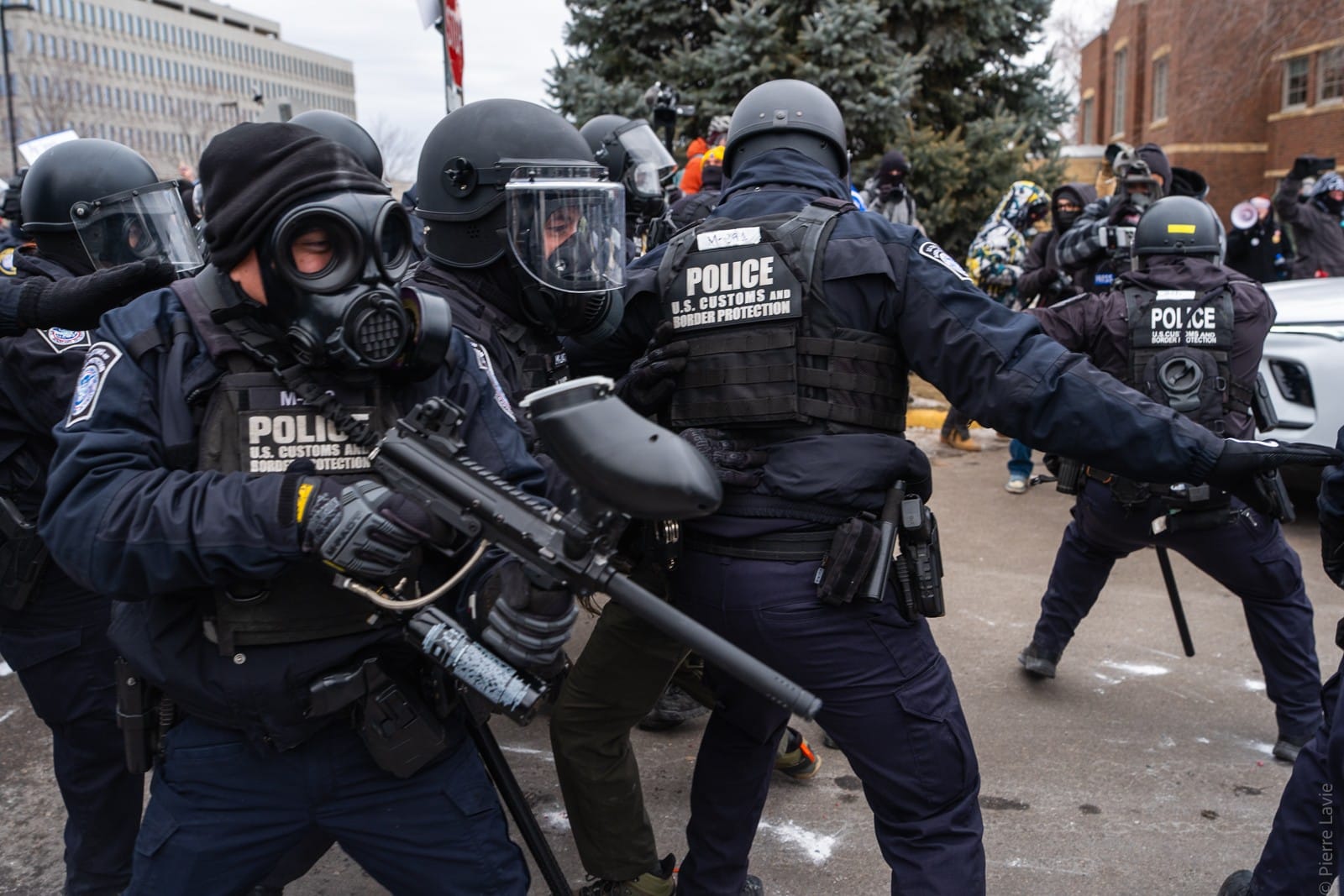
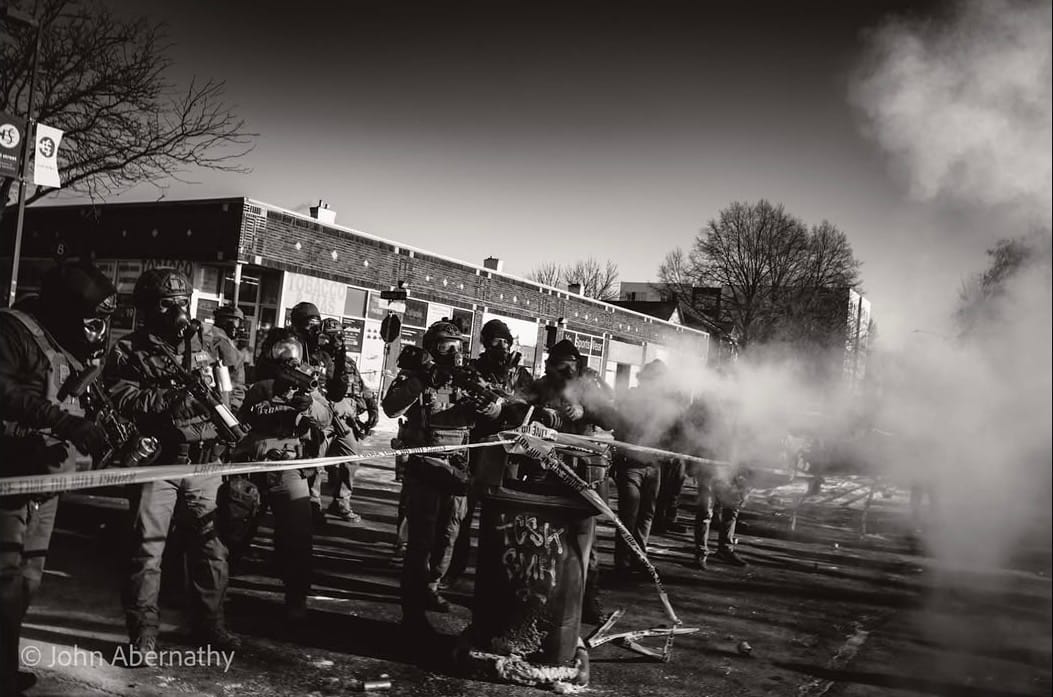
Photos: John Abernathy/@john_abernathy_ , Pierre Lavie/@just1dudewithacamera (Police)
Pierre, talk to me a bit about your kit you used for the shot of John, what are you shooting with and how are you getting images up quickly onto your pages and out to the press?
In these scenarios I'm currently shooting with two Sony A9iii cameras with a 24-70mm f/2, a 70-200mm f/2.8, and a 16mm f/1.8 in my bag, and I use Lightroom Classic to cull and edit. I have a Mira Safety full-face gas mask, body armor, and ballistic, tactical helmet.
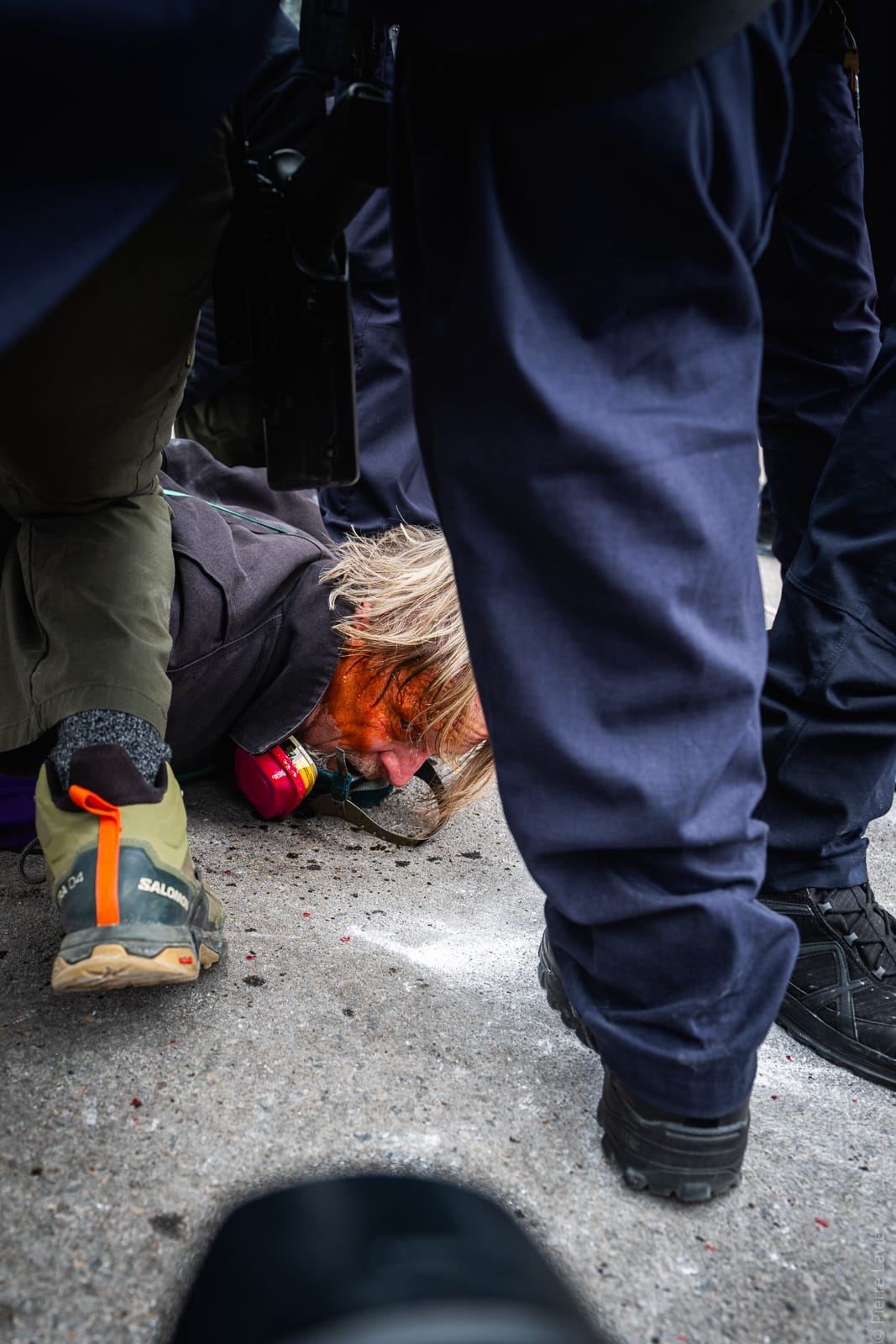
Photos: Pierre Lavie/@just1dudewithacamera
John, what power does the photographic medium carry these days? And, can a single image change opinion and effect change?
I think the single image still has a lot of power. Memories of past events seem to cling to single photos more than they do to video. The image Pierre took of me has already captured a significant audience.
It is not really a picture of me, it is a picture of freedom of the press.
But it is also a picture that represents the struggle of the people against this faceless power source.
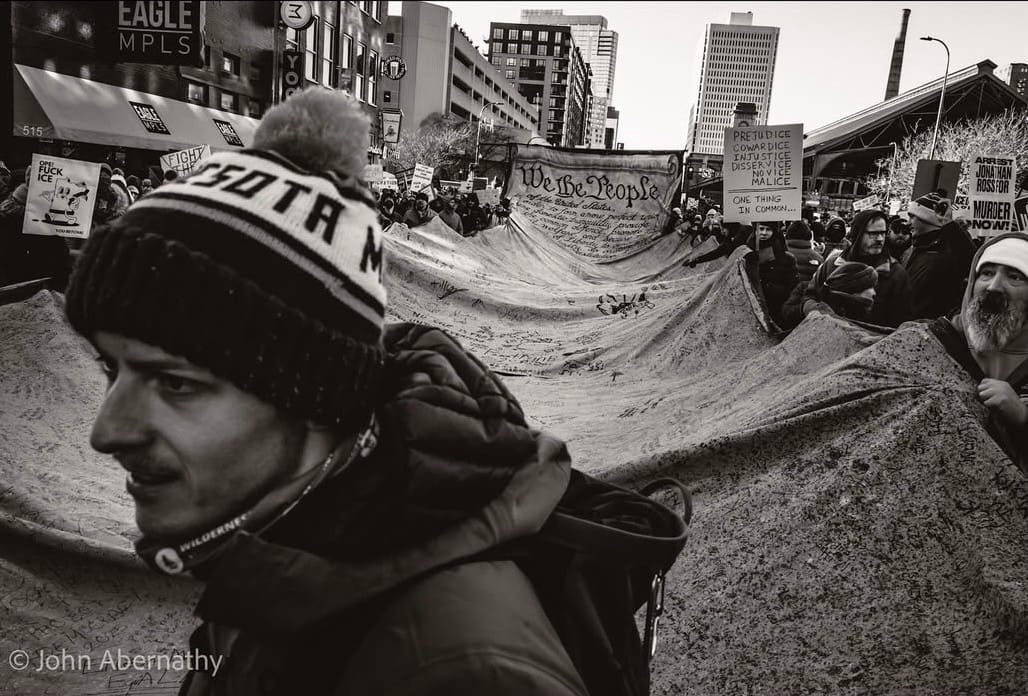
Pierre, building on that, why is documentary photography so important in telling real stories? Especially now when so much of what we are fed is altered and manipulated.
PL: Documentary photography matters because it’s one of the few remaining practices that insists on truth as both a value and a discipline. In a time when most of what we see is filtered, optimized, or outright fabricated, the documentary image becomes evidence—not just of what happened, but of who was there to witness it.
At its best, this kind of work demands honesty: from the photographer, who must tell stories without distortion or agenda; and from the audience, who must be willing to see what’s real, even when it’s uncomfortable. Storytelling through documentary photography connects people across barriers of distance and experience—it makes someone else’s reality legible, human, undeniable.
Especially now, when misinformation travels faster than the truth, documentary photography acts as a counterweight.
It preserves integrity in a visual culture that too often trades truth for engagement. Every honest frame reaffirms that facts and empathy can coexist, and that the real world—unfiltered and complex—still deserves to be seen.
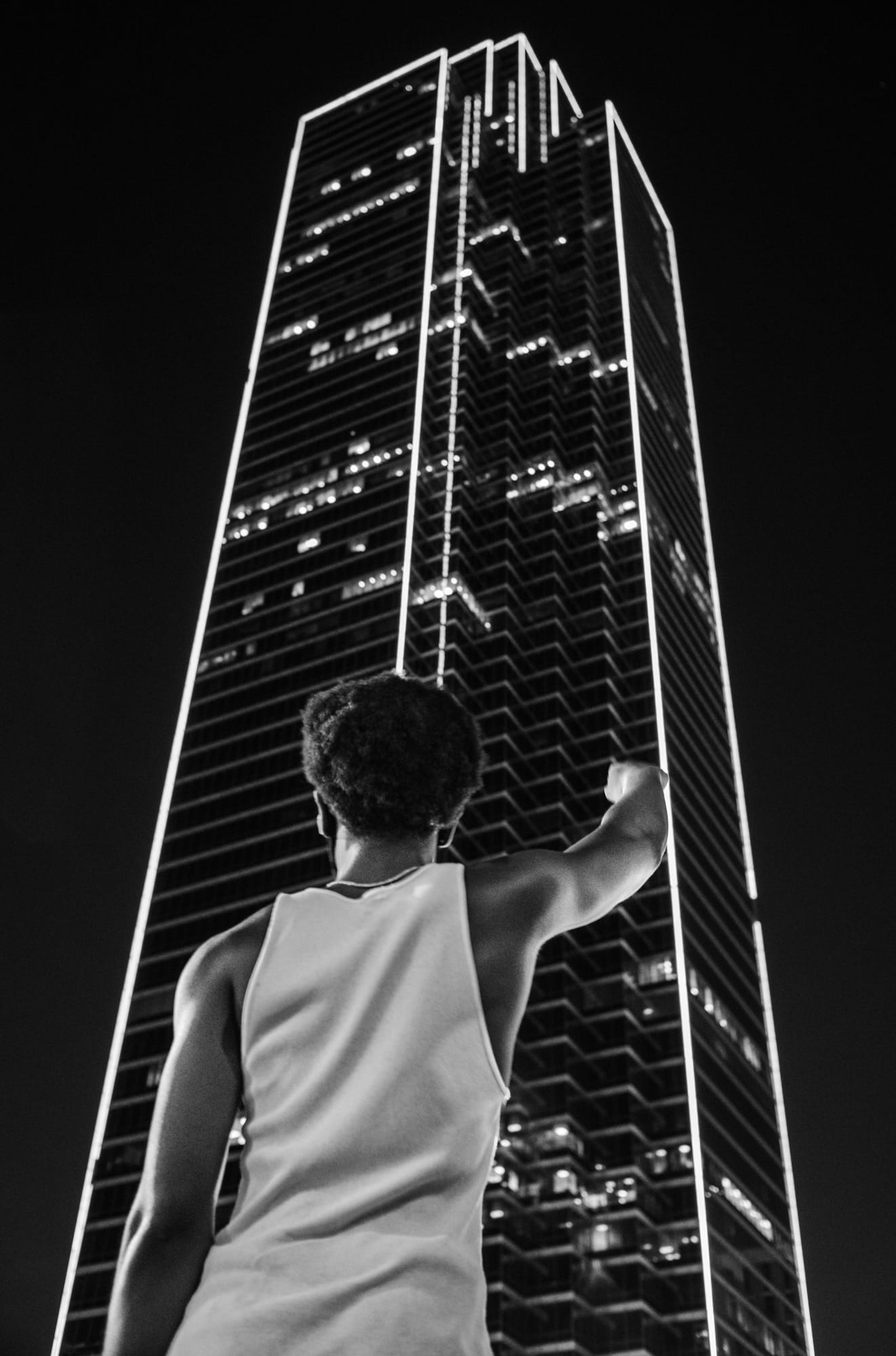
Pierre, tell me about your background as an artist and photographer, and what else were you working on before the recent documentary work?
I first picked up a camera in a college photography course, then put it down for years and didn’t return to it seriously until my wife and I had children. Becoming a parent changed the way I saw everything, and photography became a way to hold onto those small, fleeting moments. My wife and I have always been drawn to the classic Magnum-era photographers, so our home has long been filled with photo books and the kind of work that treats everyday life with real gravity and respect.
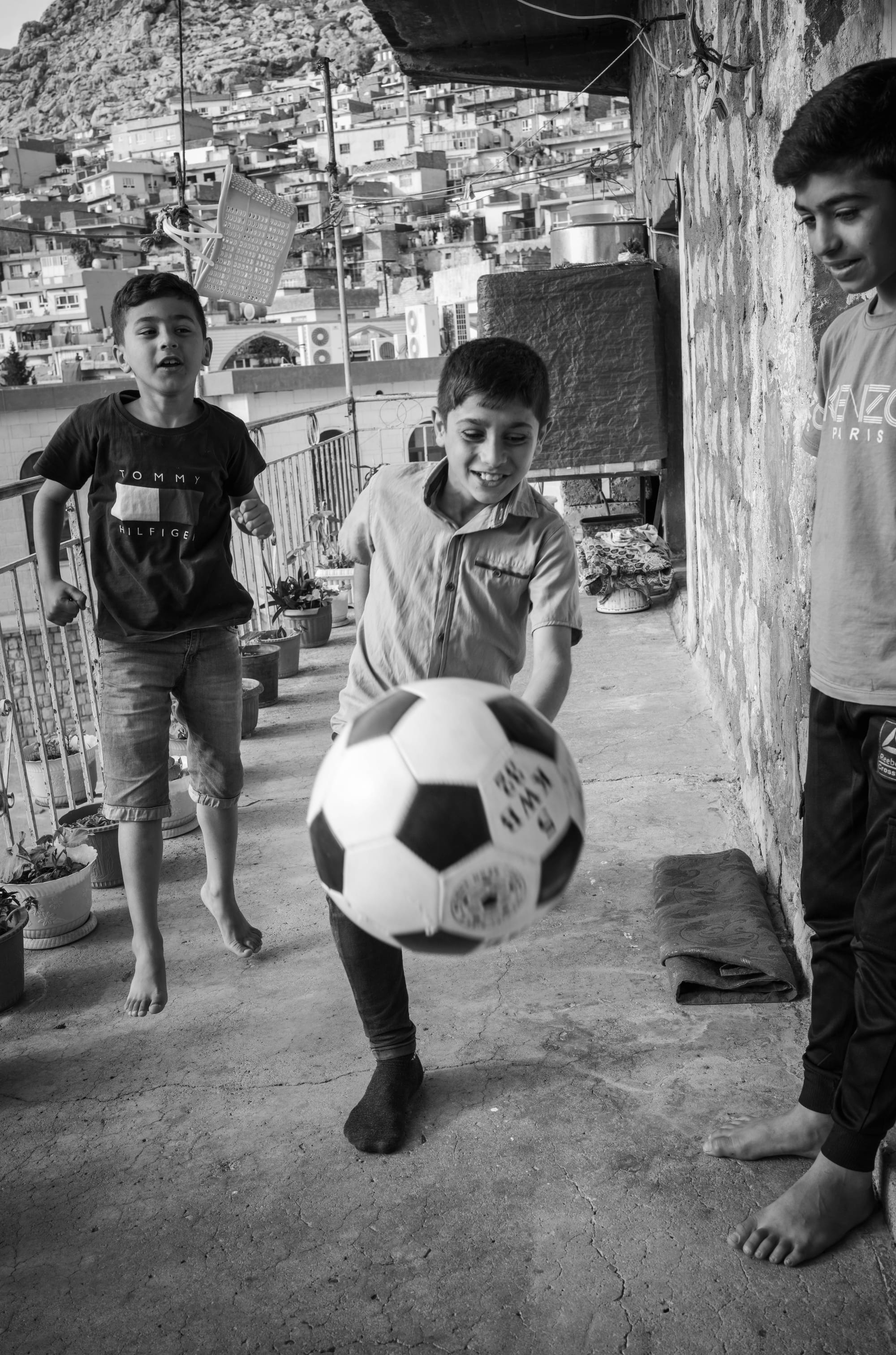
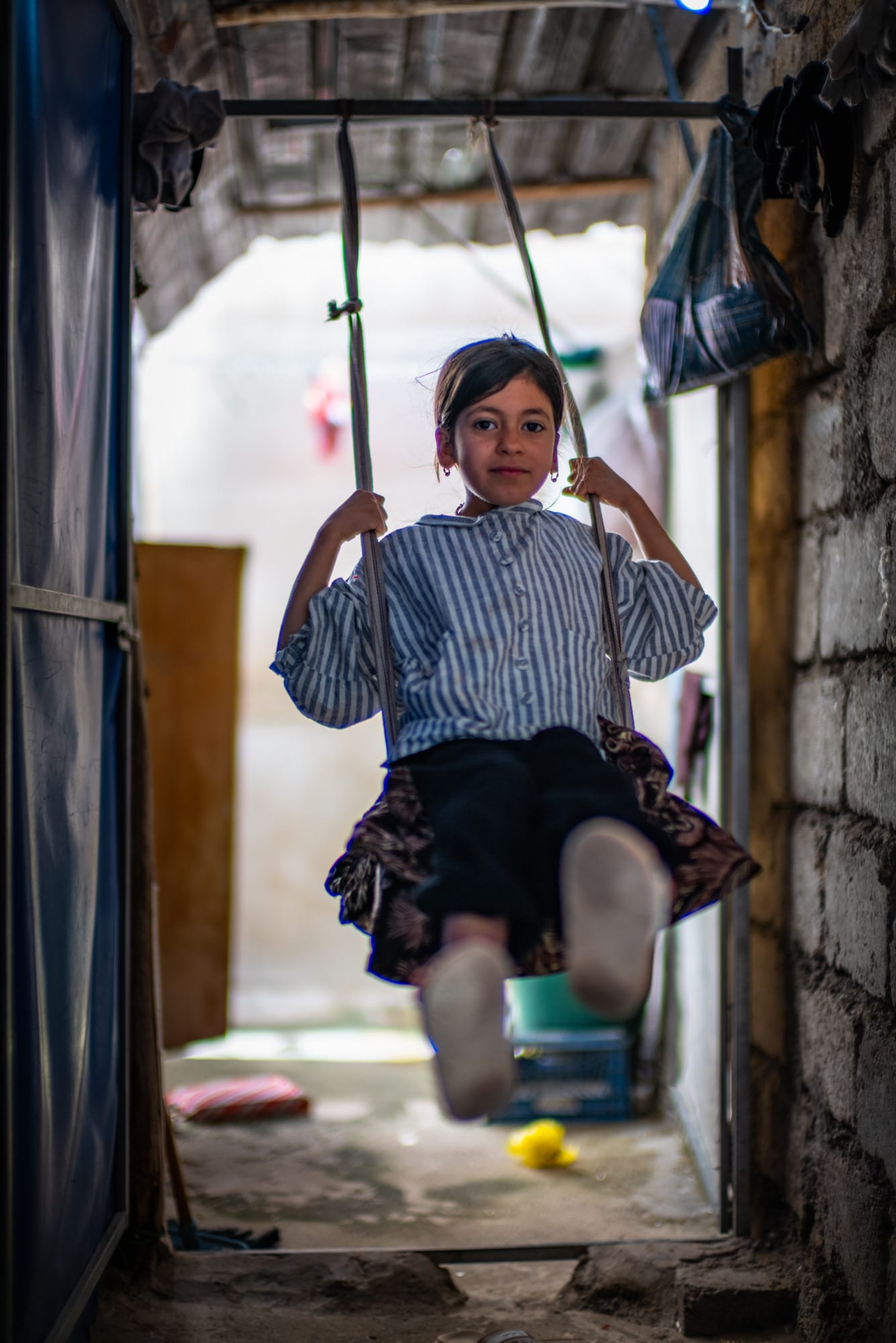
About eight years after our first child was born, I decided to try street photography. I invested in myself and my craft: I did 1:1 sessions with John Free (RIP 2024), a session with Ed Kashi through VII, and I attended workshops with Leica, The Raw Society (Jorge Delgado and Christelle Enquist) in Kurdistan, and Witness (Ricardo Azarcoya, Erika Balestra, Alain Pantaleon, Raul Cañibano, and John Stanmeyer) in Cuba. Learning from Ed was especially pivotal. He helped me understand that photography is not just about making strong images—it can also serve people and communities. He pushed me to think about attaching a civic purpose to what I do.
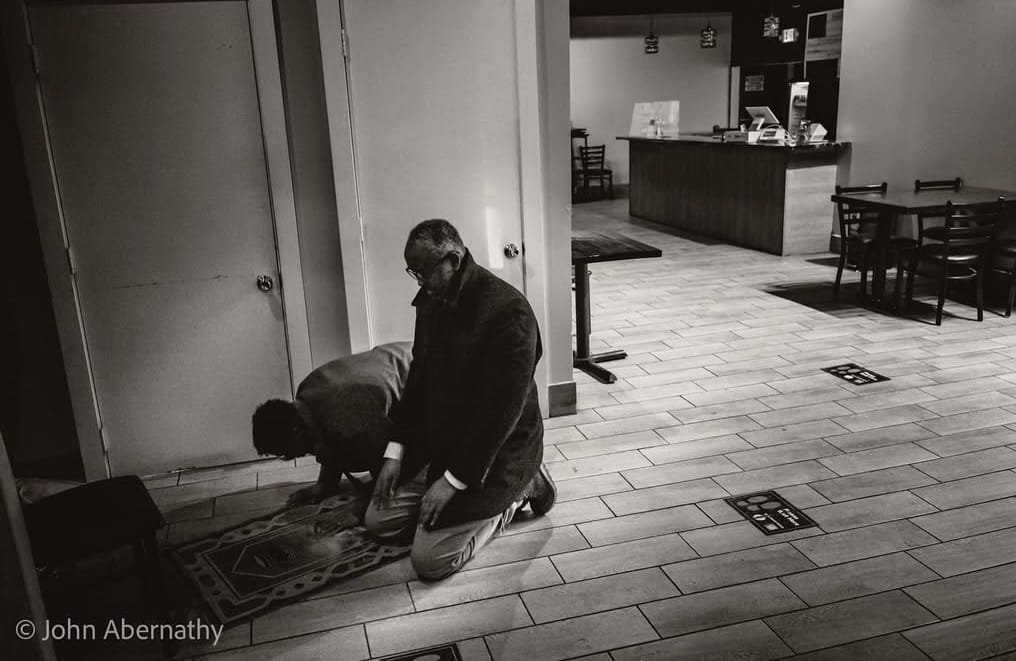
Before this recent documentary work on ICE / Border Patrol operations, I was already trying to live out that idea. I’ve been building bodies of work from Mexico, Kurdistan, Cuba, D.C., and Dallas and a few other places. I’m in the process of organizing and presenting that work with the goal of giving back to the communities I’ve photographed. My website is nearly ready, and I’ve already been fortunate to sell prints to benefit several 501(c)(3) organizations. That model—using photography to support the places and people who have trusted me with their stories—is something I’m hoping to lean into even more now.
Photos: Pierre Lavie/@just1dudewithacamera
John, what is your hope for the future, both for the society you document and the way stories are told by photographers and artists?
I definitely hope that my images and the images of other photographers around me are seen around the world. The full impact of what is happening here is not seen in our photos. Families are being torn apart. Lots of people, whether immigrant or not and regardless of race, have expressed fear towards the current situation. It is my hope that photographs and other media will be seen by the people who can make change. I hope people in other cities are learning from this great state of Minnesota on how to handle and organize against these agents. I think the total impact of the cumulative number of independent media can't be understated. If people have distrust for mainstream media they can find an independent media person to follow. In total their impact is huge.
Pierre, the image of John has given you a platform to help people focus on what is happening in Minnesota and the USA, thank you. What's next for you and is there anyone else you’d like to mention?
I'm going to continue documenting social justice issues and working to support communities through my photography. There are countless dedicated members of the press — photojournalists, journalists, and videographers, both seasoned professionals and those just beginning their journeys — out here doing this work. It truly takes all of us. I have deep respect for those who devote their lives to this profession, carry themselves with integrity, and remain steadfast in the pursuit of truth through their coverage.
A few people whose work is well worth following: Dave Decker, Adam Grey, Amanda Moore, Madison Thorn, Jon Farina, Will Allen-DuPraw, Olga Federova, Oliya Scootercaster, Jamie Keltner Davis, David Guttenfelder, Ron Haviv, Tom Hudson, JT Cestkowski, Zach D. Roberts, Seth Herald, Ford Fischer — and many more. It really does take a village.
We're constantly on the look out for new artists, creatives and initiatives to feature in TheNeverZine - so if you are, or know someone who is going their own way and doing their own thing on their own terms and would be a good fit to feature please smash that button below and get in contact. By talking to each other, and sharing our journeys, ideas and insights on creativity, art, mental health and resilience we can all create, share and thrive together. Nice thought that.
PS - Don't forget to subscribe below for more content from TheNeverPress 👇